|
The GSI Fragment Separator Website Your portal to information about the FRS! |
|
| People Research Meetings Technical info |
The FRS acquisition in stand-alone mode
The FRS data acquisition can be run in stand-alone mode or as part of more complicated systems.
The
stand-alone mode, schematically described in Figure 1, is based on two processors: a data sender
and a data receiver.
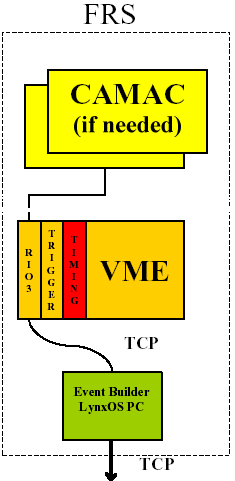
Figure 1. A schematic representation of the FRS acquisition in stand-alone mode.
The data sender is a RIO-3 processor, running under Lynx-OS, which resides in the FRS VME crate.
It handles the readout of the digitizers (ADCs, QDCs etc.) and then passes the data via TCP/IP on to the second processor.
This is a PC, also running Lynx-OS, which acts as data receiver. Its job is to act as event builder, and to make these available for further processing, such as storage or by analysis clients.
The PC is situated next to the storage cabinets in the electronics area of the FRS Messhütte.
At present the RIO-3 also controls access to two CAMAC crates - one can be used for digitizers if needed, and the other houses the constant fraction discriminators and multiplexers used for slow-control of the MW detector signals.
The slow-control Labview program connects to the CAMAC crates via the Esone server task running as part of the normal data acquisition environment of the RIO-3 processor.
(If MBS is not running, the slow-control applications are also disabled!)
The FRS web pages have been accessed 26997 times since October 27, 2003!
Script file last updated on July 21, 2006.